
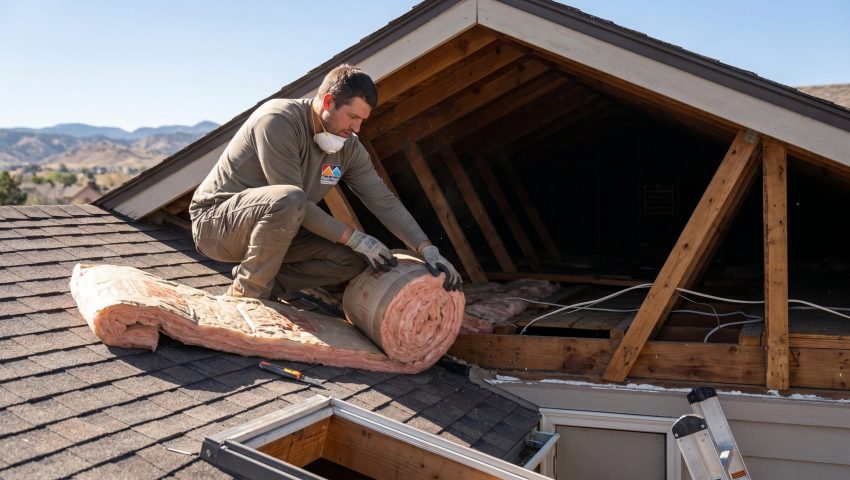
Optimizing roof insulation requires strategic assessment and proper installation techniques. This guide delivers measurable energy savings through proven methods.
Most homeowners across Denver, Aurora, and surrounding Colorado communities lose 25-40% of their heating and cooling energy through poorly optimized roof insulation. The problem isn’t just insufficient R-values, it’s the hidden air leaks, thermal bridges, and moisture issues that turn even premium insulation into an expensive underperformer. When you optimize roof insulation correctly, you’re not just adding material to your attic, you’re creating a comprehensive thermal barrier that can cut energy bills by 15-30% while eliminating ice dams and uncomfortable temperature swings. The difference between thrown-in insulation and optimized insulation is the difference between wasted money and genuine energy savings.
This guide walks you through the complete process to optimize roof insulation for maximum energy efficiency, from conducting a proper thermal assessment to verifying your results with measurable data. You’ll learn how to identify the specific weak points in your roof assembly, select the right combination of materials for Colorado’s climate, and install everything to work as an integrated system rather than individual components. By following these steps, you’ll understand exactly why some homes stay comfortable year-round while others struggle with high energy bills and uneven temperatures, and you’ll have the knowledge to put your home in the first category.
Step 1: Conduct a Comprehensive Thermal Assessment
Before you can optimize roof insulation effectively, you need to understand exactly where your current system is failing and what specific improvements will deliver the biggest impact. This assessment involves measuring existing insulation depths, identifying air leakage points, checking ventilation balance, and documenting thermal bridges that bypass your insulation entirely. The goal isn’t just to find obvious problems like missing insulation, it’s to map the complete thermal performance of your roof assembly so you can prioritize improvements that actually reduce energy waste. Most energy audits focus on basic insulation requirements, but a proper optimization assessment looks at how air, heat, and moisture move through your entire roof system.
Skipping this diagnostic phase leads to expensive mistakes like adding insulation over major air leaks, which provides minimal benefit, or choosing the wrong insulation type for your specific roof assembly and climate conditions. You’ll know this step is complete when you have documented measurements of current R-values in different areas, identified the top three air leakage sources, confirmed your ventilation meets the 1:150 or 1:300 ratio requirements, and mapped any structural elements creating thermal bridges. This data becomes your roadmap for the material selection process, ensuring every dollar spent on insulation optimization delivers measurable energy savings rather than just higher R-value numbers on paper.
Here’s a comparison of key assessment areas and what to measure in each:
| Assessment Area | What to Measure | Target Performance |
|---|---|---|
| Existing Insulation | Depth and R-value by zone | R-49 attic, R-38 cathedral ceiling |
| Air Leakage | CFM50 with blower door test | Under 5 ACH50 for efficiency |
| Ventilation Balance | Net free area intake vs exhaust | 1:1 ratio, 1 sq ft per 150 sq ft |
| Thermal Bridges | Structural penetrations | Minimize uninsulated connections |
| Moisture Issues | Condensation signs, vapor barriers | Proper vapor retarder class for climate |
Step 2: Select Materials Based on Performance Requirements
The biggest mistake in roof insulation optimization is choosing materials based on cost per square foot rather than performance per dollar over the system’s lifetime, which leads to underperforming assemblies that never deliver the promised energy savings. Different insulation types have dramatically different strengths and weaknesses in Colorado’s climate, and the optimal choice depends on your specific roof assembly, moisture conditions, and whether you’re dealing with cathedral ceilings, traditional attics, or low-slope commercial roofs. For example, blown-in cellulose provides excellent air sealing in irregular spaces, while rigid foam boards eliminate thermal bridging but require careful vapor management to prevent condensation issues.
The key is matching material properties to your specific performance requirements rather than defaulting to whatever’s cheapest or most commonly available. Pay attention to how different materials handle moisture, temperature cycling, and long-term R-value retention, especially since some foam insulations experience thermal drift that reduces their effectiveness over time. You’ll also need to consider installation constraints like access limitations, fire safety requirements, and compatibility with existing roof assemblies when selecting your optimization strategy.
Material Selection Factors
- R-Value Stability: Choose materials that maintain thermal performance over time, avoiding products prone to settling or thermal drift that reduce effectiveness within 5-10 years of installation.
- Moisture Compatibility: Match vapor permeance to your climate zone and roof assembly, selecting Class I, II, or III vapor retarders based on heating vs cooling loads and existing moisture barriers.
- Air Sealing Properties: Prioritize materials that provide both thermal resistance and air barrier functions, such as spray foam or properly detailed rigid boards, to eliminate convective heat loss.
- Installation Requirements: Consider access constraints, fire safety codes, and compatibility with existing systems when choosing between loose-fill, batt, rigid board, or spray foam applications for your specific project.
Once you’ve matched materials to your performance requirements and installation constraints, you’ll have a clear specification that optimizes both thermal performance and long-term durability for your specific roof assembly. This material selection becomes the foundation for the installation planning phase, where you’ll determine the sequence and techniques needed to achieve continuous thermal barriers without compromising structural integrity or moisture management. The goal is creating an integrated system where every component works together rather than just adding more insulation to an existing assembly.
Step 3: Execute Installation with Continuous Thermal Barriers
Proper installation of optimized roof insulation requires creating continuous thermal barriers that eliminate the air leakage and thermal bridging that compromise even premium materials, which means going far beyond simply adding more insulation to existing assemblies. This phase involves sealing all air leakage paths first, installing insulation to achieve continuous coverage without gaps or compression, and ensuring proper ventilation pathways remain clear where required by code. The installation sequence matters critically, you must complete air sealing before adding insulation, install vapor barriers on the correct side of the assembly for your climate, and maintain proper clearances around heat sources and structural elements. Professional installation techniques focus on eliminating thermal bridges at critical junctions like wall-to-roof connections, penetrations, and structural members.
The most common installation failures occur when contractors rush through air sealing or compromise thermal barriers to save time, which can reduce system performance by 30-50% even with high-quality materials. You’ll know this step is complete when you have continuous insulation coverage with no gaps larger than 1/4 inch, all penetrations properly sealed with compatible materials, vapor barriers correctly positioned and sealed at seams, and ventilation pathways clear and unobstructed where required. Document your installation with photos and measurements, as this becomes crucial for warranty compliance and future maintenance planning, plus it allows you to verify the installation meets the specifications developed during your assessment and material selection phases.
Step 4: Verify Performance and Document Results
The final step in roof insulation optimization is confirming that your installation actually delivers the energy performance improvements you invested in, because even perfect materials and installation techniques can fail to meet expectations if the system doesn’t function as designed. This verification process involves conducting post-installation testing to measure air leakage reduction, thermal imaging to confirm continuous insulation coverage, and monitoring energy usage to document actual savings compared to pre-optimization baselines. Many homeowners skip this step and never know whether their insulation optimization succeeded, which means they can’t identify problems early or make adjustments to maximize their investment.
Performance verification also provides the documentation needed for utility rebates, warranty claims, and future maintenance decisions, plus it gives you confidence that your optimization project achieved its goals. Energy efficiency verification typically includes blower door testing to confirm air leakage reduction, infrared thermography to identify any remaining thermal bridges, and energy monitoring to track actual utility bill improvements over the first year of operation.
Verification Methods
- Blower Door Testing: Conduct post-installation testing to confirm air leakage reduction, targeting at least 15-20% improvement in CFM50 readings compared to pre-optimization baseline measurements.
- Thermal Imaging: Use infrared cameras during heating or cooling periods to identify any remaining thermal bridges, gaps, or areas where insulation performance doesn’t match specifications.
- Energy Monitoring: Track monthly utility usage for 12 months post-installation to document actual energy savings, comparing to weather-normalized baselines from previous years to account for seasonal variations.
With performance verification complete, you have documented proof that your roof insulation optimization delivers the energy savings and comfort improvements you invested in achieving. This documentation becomes valuable for warranty claims, insurance purposes, and future maintenance planning, plus it provides the confidence that your optimization project succeeded in creating a high-performance thermal barrier. The verification data also helps you understand which specific improvements delivered the biggest impact, information that’s useful for future optimization projects or recommendations to neighbors facing similar energy efficiency challenges across the Denver metro area.
Maximizing Your Investment Returns
By following this systematic approach to optimize roof insulation, you’ve transformed your roof assembly from an energy liability into a high-performance thermal barrier that will deliver measurable savings for decades. The combination of proper assessment, strategic material selection, continuous installation, and performance verification ensures your investment provides maximum energy efficiency rather than just higher R-value numbers on paper. Most homeowners who complete this optimization process see 15-30% reductions in heating and cooling costs, plus improved comfort and elimination of issues like ice dams and uneven temperatures that plague poorly insulated homes.
Monitor your energy usage over the next 12 months to track your actual savings, and schedule annual inspections to ensure your optimized insulation system continues performing at peak efficiency. If you’re planning additional energy efficiency improvements, consider how roof insulation optimization integrates with solar panel installation or complete roof replacement projects to maximize your overall energy performance. The techniques you’ve learned here apply to any climate, but the specific material choices and installation details should always be adapted to your local conditions and building codes for optimal results.
Author
JJ Hedden is the owner of Peak to Peak Roofing, bringing 15 years of hands-on experience helping Colorado homeowners optimize their roof systems for maximum energy efficiency. His expertise in building science and thermal performance comes from completing over 6,000 roofing projects across the Denver metro area, where extreme temperature swings and intense solar radiation create unique challenges for roof insulation systems. JJ’s approach focuses on proven techniques that deliver measurable energy savings rather than quick fixes that look good on paper but fail in real-world conditions.