
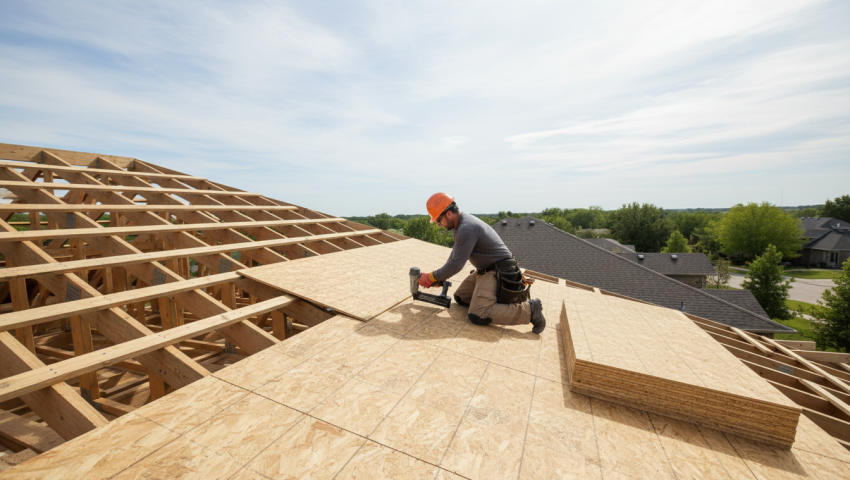
Expert Insight: Most roof failures start with inadequate decking that meets code but fails under real-world conditions. Proper decking thickness and fastening prevents 80% of premature roof replacements.
Most homeowners in Denver, Colorado focus on shingles and gutters when planning a roof replacement, but the foundation beneath those visible materials determines whether your investment lasts 15 years or 50. Your roof decking acts as the structural backbone that distributes weight, resists wind uplift, and creates the stable platform your entire roofing system depends on. When contractors cut corners on decking specifications or installation techniques, you’re left with a roof that looks perfect from the street but harbors hidden vulnerabilities.
The roof decking importance becomes crystal clear when you understand that Colorado’s extreme weather patterns place unique demands on your home’s structure. Denver’s heavy snow loads, rapid temperature swings, and severe hailstorms require decking that goes beyond minimum building code requirements to truly protect your investment. This guide reveals the critical decking decisions that separate reliable roofs from expensive failures, helping you make informed choices that protect both your home and your wallet.
Key Takeaways
- Code Compliance Isn’t Enough: Minimum building code allows 7/16-inch OSB that often fails under Denver’s snow loads and wind conditions, requiring thicker materials for real-world durability and performance.
- Warranty Dependencies: Shingle manufacturers void warranties when decking thickness falls below their specifications, even if local codes permit thinner materials, leaving homeowners financially exposed to premature failures.
- Fastener Precision Matters: Incorrect nail spacing or fastener type violates manufacturer requirements and reduces wind resistance by up to 40%, creating dangerous uplift conditions during Colorado’s severe thunderstorms.
- Material Selection Impact: Plywood costs 40% more than OSB initially but provides superior moisture resistance and fastener holding power, preventing costly repairs from Denver’s freeze-thaw cycles.
- Hidden Damage Timeline: Poor decking preparation allows moisture infiltration that remains invisible for 2-3 years before causing catastrophic structural damage, mold growth, and insurance claim complications.
Why Half-Inch OSB Decking Fails Even When It Meets Building Code
Denver building codes permit 7/16-inch OSB sheathing for most residential applications, but this minimum standard creates a false sense of security for homeowners. The reality is that code requirements represent the absolute minimum for structural safety, not optimal performance under Colorado’s challenging climate conditions. When snow loads exceed 30 pounds per square foot or wind gusts reach 80+ mph during Front Range chinook events, that thin decking flexes beyond manufacturer tolerances.
The problem isn’t just immediate failure, it’s the gradual degradation that occurs when decking operates at its structural limits. APA engineered wood standards show that 7/16-inch panels experience significant deflection under normal loads, creating micro-movements that loosen fasteners over time. This movement allows water penetration at nail holes and panel joints, starting the moisture damage cycle that ultimately destroys the entire roof system.
Here’s how different decking thicknesses perform under typical Denver weather conditions:
| Decking Thickness | Snow Load Capacity | Wind Uplift Resistance | Expected Lifespan |
|---|---|---|---|
| 7/16-inch OSB | 30 psf (minimum) | 90 psf | 15-20 years |
| 5/8-inch OSB | 45 psf | 120 psf | 25-30 years |
| 3/4-inch Plywood | 60 psf | 150 psf | 40-50 years |
Structural Weaknesses
- Deflection Limits: Code-minimum decking deflects L/240 under snow loads, causing visible sagging and stress concentrations that crack sealants and allow water infiltration.
- Fastener Withdrawal: Thin OSB provides inadequate nail penetration depth, reducing withdrawal resistance by 35% compared to thicker materials during wind uplift events.
- Panel Spacing: Minimum thickness requires precise 16-inch spacing that many framers exceed, creating unsupported spans that fail under concentrated loads from ice dams.
- Moisture Absorption: 7/16-inch panels reach saturation faster during Denver’s wet spring months, causing edge swelling that telegraphs through shingles and creates leak points.
- Temperature Cycling: Colorado’s extreme temperature swings cause thin panels to expand and contract more dramatically, loosening fasteners and creating gaps at panel joints.
The solution isn’t just upgrading to thicker materials, it’s understanding how decking thickness interacts with your specific roof design and local weather patterns. Experienced contractors in Denver, Colorado recognize that saving $200 on decking material often costs thousands in premature roof replacement. Smart homeowners invest in 5/8-inch or 3/4-inch decking that provides the structural margin needed for long-term performance under real-world conditions.
The Hidden Water Damage That Shows Up Three Years After Installation
Water damage from poor decking installation doesn’t announce itself with dramatic leaks or obvious stains. Instead, it begins as microscopic moisture infiltration at fastener penetrations and panel joints, creating conditions for mold growth and wood rot that remain hidden inside wall cavities and attic spaces. By the time homeowners notice musty odors or visible damage, the deterioration has often spread throughout the roof structure.
The three-year timeline isn’t coincidental, it reflects the natural progression of moisture damage in wood-based building materials. Initial exposure causes gradual moisture content increases that weaken wood fibers and create ideal conditions for fungal growth. Building science research shows that sustained moisture levels above 20% trigger irreversible decay processes that accelerate exponentially once established.
Damage Progression
- Fastener Corrosion: Moisture infiltration causes nail and screw corrosion that reduces holding power by 60% within 24 months, creating loose connections throughout the roof system.
- Mold Colonization: Hidden moisture creates mold growth in attic insulation and wall cavities, triggering health issues and requiring expensive remediation that insurance rarely covers completely.
- Structural Degradation: Wood rot spreads from initial moisture entry points to adjacent framing members, requiring extensive structural repairs that can cost $15,000-$25,000 in severe cases.
- Insulation Damage: Moisture-saturated insulation loses R-value and becomes a breeding ground for pests, requiring complete replacement and significantly increasing energy costs throughout the home.
- Secondary Failures: Weakened decking allows shingle movement that accelerates granule loss and creates additional leak points, turning isolated moisture problems into widespread roof system failure.
Prevention requires understanding that proper decking installation isn’t just about meeting code requirements, it’s about creating a moisture management system that protects your home for decades. Quality contractors use ice and water barriers at all penetrations and vulnerable areas, ensuring that minor moisture infiltration gets directed away from structural components rather than absorbed into the building envelope.
How Decking Thickness Changes Your Shingle Warranty Coverage
Shingle manufacturers maintain strict installation requirements that often exceed local building codes, and decking thickness sits at the top of that list. GAF, Owens Corning, and other major manufacturers void warranties when installers use decking thinner than their specifications, regardless of whether that thickness meets Denver building codes. This creates a dangerous gap where homeowners believe they’re protected when they’re actually exposed to complete financial liability.
The warranty implications extend beyond just material defects to include wind damage, hail impact resistance, and premature aging claims. When manufacturers investigate warranty claims, they examine installation photos and may require destructive testing to verify decking thickness and fastener compliance. Homeowners who discover their decking doesn’t meet manufacturer specifications often face denial of claims worth tens of thousands of dollars.
Warranty Requirements
- Minimum Thickness: Most premium shingle lines require 5/8-inch minimum decking thickness, voiding warranties on homes with code-minimum 7/16-inch materials regardless of installation quality.
- Fastener Specifications: Warranty coverage requires specific nail lengths and spacing patterns that change based on decking thickness, creating complex installation requirements that many contractors ignore.
- Documentation Requirements: Manufacturers increasingly require installation photos showing decking thickness and fastener patterns, making warranty claims impossible without proper documentation during installation.
- Wind Resistance Ratings: Published wind resistance ratings only apply when installed over manufacturer-specified decking thickness, reducing actual performance ratings by 20-30% on thinner substrates.
- Hail Impact Coverage: Impact-resistant shingles lose their Class 4 hail rating when installed over inadequate decking, eliminating insurance discounts and leaving homeowners exposed to storm damage costs.
Smart homeowners verify manufacturer requirements before installation begins, ensuring their investment receives full warranty protection. This means requesting written confirmation that decking specifications meet or exceed manufacturer minimums, not just local code requirements. The extra cost of proper decking thickness pays for itself through warranty protection and enhanced performance during Denver’s severe weather events.
The Fastener Spacing Mistake That Voids Most Manufacturer Warranties
Nail spacing represents the most commonly violated installation requirement in residential roofing, yet it’s also the most critical for wind resistance and warranty compliance. IRC building codes specify 6-inch spacing at panel edges and 12 inches in the field, but shingle manufacturers require tighter spacing for warranty coverage. The difference between code-compliant and warranty-compliant fastening can mean the difference between a roof that survives Denver’s severe thunderstorms and one that fails catastrophically.
The physics behind fastener spacing requirements becomes clear when you understand how wind uplift forces work on roof systems. Each fastener must resist specific loads calculated based on roof area, building height, and local wind speeds. When spacing exceeds manufacturer specifications, individual fasteners experience loads beyond their design capacity, creating failure points that propagate across the entire roof system during high-wind events.
Installation Standards
- Edge Fastening: Manufacturer warranties require 4-inch spacing at panel edges versus code-allowed 6 inches, increasing wind resistance by 40% but adding labor costs that many contractors avoid.
- Field Spacing: Premium shingle warranties specify 8-inch field spacing rather than code-minimum 12 inches, requiring 50% more fasteners and significantly increasing installation time and material costs.
- Fastener Type: Ring-shank nails provide 25% better withdrawal resistance than smooth nails but cost twice as much, leading many contractors to use cheaper alternatives that void warranties.
- Penetration Depth: Proper nail penetration requires extending 3/4 inch into framing members, but thin decking reduces available penetration depth and compromises holding power under uplift loads.
- Pattern Consistency: Manufacturers require consistent fastener patterns documented with installation photos, but field conditions often force deviations that void warranty coverage even when structural performance remains adequate.
Protecting your warranty requires contractors who understand that fastener specifications aren’t suggestions, they’re contractual requirements for coverage. Quality installers use chalk lines to ensure consistent spacing and document their work with photos that prove compliance. The additional labor cost for proper fastening typically adds less than $300 to a typical roof replacement but protects warranty coverage worth thousands of dollars.
Why Plywood Costs 40% More But Saves Money Long-Term
The price difference between OSB and plywood sheathing reflects fundamental differences in manufacturing processes and long-term performance characteristics. Plywood’s cross-laminated construction provides superior moisture resistance and dimensional stability, while OSB’s strand orientation creates weak points that allow moisture penetration and edge swelling. In Denver’s climate, where freeze-thaw cycles and rapid temperature changes stress building materials, plywood’s performance advantages justify the higher initial investment.
The long-term savings from plywood become apparent when you calculate replacement costs, energy efficiency impacts, and maintenance requirements over a 30-year period. Homes with plywood decking experience fewer callbacks for loose shingles, reduced air infiltration, and better insulation performance due to the material’s dimensional stability. These factors combine to create total cost of ownership advantages that far exceed the initial price premium.
Performance Advantages
- Moisture Resistance: Plywood’s layered construction prevents moisture wicking that causes OSB edge swelling, maintaining flat surfaces that prevent shingle distortion and premature wear patterns.
- Fastener Holding: Cross-grain lamination provides 35% better nail withdrawal resistance compared to OSB, reducing fastener loosening during thermal cycling and wind events common in Colorado.
- Dimensional Stability: Plywood maintains consistent thickness and flatness through temperature extremes, preventing the telegraphing and buckling issues that plague OSB installations in Denver’s climate.
- Repair Compatibility: Individual plywood panels can be replaced without affecting adjacent panels, while OSB repairs often require larger sections due to edge damage and moisture contamination.
- Resale Value: Homes with plywood decking command higher resale prices and pass inspections more easily, providing measurable return on investment when homeowners decide to sell.
The decision between OSB and plywood shouldn’t be based solely on initial cost but on total lifecycle value. Experienced contractors in Denver, Colorado recommend plywood for homeowners planning to stay in their homes long-term or those seeking maximum weather resistance. The 40% price premium typically pays for itself through reduced maintenance costs and improved performance within the first decade of service.
The Structural Red Flag Most Homeowners Never See Coming
Roof sagging often develops so gradually that homeowners don’t notice the warning signs until structural damage becomes severe and expensive to repair. The process typically begins with inadequate decking thickness or improper fastening that allows small amounts of deflection under normal loads. Over time, this deflection increases as fasteners loosen and materials fatigue, creating a cascading failure that can compromise the entire roof structure.
The danger isn’t just cosmetic, sagging roofs create water pooling areas that accelerate deterioration and can lead to sudden collapse during heavy snow events. Structural engineering studies show that roofs exhibiting visible sag have often lost 40-60% of their original load-carrying capacity, putting occupants at risk during Denver’s heavy snowfall periods when loads can exceed 50 pounds per square foot.
Warning Signs
- Ceiling Cracks: Hairline cracks in drywall ceilings often indicate roof movement and structural stress that will worsen over time, requiring immediate professional evaluation to prevent catastrophic failure.
- Door Misalignment: Interior doors that stick or won’t close properly may indicate roof loading that’s causing wall movement, suggesting inadequate decking support throughout the structure.
- Visible Deflection: Any noticeable sagging in roof lines indicates structural overload that requires immediate attention, as visible deflection represents advanced deterioration with safety implications.
- Water Staining: Ceiling stains in multiple rooms suggest widespread moisture infiltration from poor decking performance, indicating systemic problems rather than isolated leaks.
- Energy Cost Increases: Rising heating and cooling costs can indicate air infiltration from structural movement that compromises building envelope integrity and reduces insulation effectiveness.
Prevention requires understanding that structural problems develop slowly but accelerate rapidly once critical thresholds are exceeded. Homeowners should schedule professional inspections every 5-7 years to identify early warning signs before they become expensive emergencies. Quality contractors can assess decking adequacy and recommend preventive measures that cost thousands less than emergency structural repairs.
How Poor Decking Preparation Doubles Your Replacement Timeline
Roof replacement projects that should take 2-3 days often stretch to a week or more when contractors discover decking problems during tear-off. What homeowners don’t realize is that decking condition directly impacts every subsequent installation step, from underlayment application to final cleanup. When existing decking fails inspection or doesn’t meet current code requirements, the entire project timeline shifts as contractors source materials and coordinate additional work.
The timeline impact extends beyond just material delays to include permit modifications, inspection scheduling, and weather protection requirements. Denver’s unpredictable weather makes exposed decking particularly vulnerable, requiring contractors to maintain temporary coverings that add complexity and cost to every project day. Smart planning includes decking assessment before tear-off begins, allowing accurate timeline estimates and proper material ordering.
Here’s how different preparation approaches affect typical roof replacement timelines:
| Preparation Level | Assessment Phase | Installation Timeline | Weather Risk |
|---|---|---|---|
| Minimal | Visual only | 2-7 days (variable) | High exposure risk |
| Standard | Probe testing | 3-4 days (predictable) | Moderate protection |
| Comprehensive | Moisture/structural analysis | 2-3 days (efficient) | Minimal exposure |
Timeline Factors
- Material Sourcing: Decking replacement requires lumber yard deliveries that may take 2-3 days during busy construction seasons, leaving homes exposed to weather while materials are sourced.
- Permit Modifications: Structural decking work often requires permit amendments and additional inspections that add 3-5 business days to project timelines, particularly in Denver’s busy construction market.
- Weather Protection: Exposed decking requires temporary covering during delays, adding daily labor costs and complicating work scheduling around Denver’s afternoon thunderstorm patterns.
- Inspection Delays: Building department inspections for structural work may require 48-72 hour scheduling notice, creating mandatory waiting periods that extend project duration regardless of contractor availability.
- Crew Coordination: Decking work requires framing crews in addition to roofing teams, creating scheduling conflicts that can delay projects by a week or more during peak construction periods.
Minimizing timeline disruption requires thorough decking assessment during initial estimates, not after tear-off reveals problems. Quality contractors use moisture meters and probing tools to identify potential issues before work begins, allowing accurate timeline estimates and proper planning. This proactive approach protects homeowners from unexpected delays and cost overruns that turn routine roof replacements into extended construction projects.
Building Denver Roofs That Last
Understanding roof decking importance transforms how you approach roofing decisions, shifting focus from visible materials to the structural foundation that determines long-term performance. The contractors who recognize that proper decking isn’t an expense but an investment create roofs that protect Denver homes through decades of extreme weather. When you prioritize decking thickness, fastener specifications, and moisture management, you’re building a system designed for Colorado’s unique challenges rather than just meeting minimum requirements.
Your roof decking decision impacts everything from warranty coverage to resale value, making it one of the most important choices in your roofing project. If you’re planning a roof replacement in Denver, Colorado and want to ensure your investment provides maximum protection and performance, we can help you navigate the technical requirements and material options. Contact us for a comprehensive assessment that evaluates your existing decking condition and recommends solutions designed for long-term success in our challenging climate.
Author
JJ Hedden is the owner of Peak To Peak Roofing with 15 years of experience helping Denver homeowners navigate complex roofing decisions. His hands-on approach to roof decking evaluation has prevented countless expensive failures by identifying structural issues before they become emergencies. JJ’s expertise in Colorado’s unique weather challenges and building requirements ensures homeowners make informed decisions that protect their investments for decades.